You have no idea how hard I've looked
for a gift to bring You.
Nothing seemed right.
What's the point of bringing gold to
the gold mine, or water to the ocean.
... Everything I came up with was like
taking spices to the Orient.
It's no good giving my heart and my
soul because you already have these.
So I've brought you a mirror.
Look at yourself and remember me. ♥
Rumi ♥
I was dead, I came alive. I was tear, I became laughter - all because of love. When it arrived, my temporal life from then on changed to eternal. Love said to me, "You are not crazy enough, you do not fit this house." I went and became crazy; crazy enough to be in chains. Love said, "You are not intoxicated enough; you don't fit the group." I went and got drunk, drunk enough to overflow with the light-headedness. Love said, "You are still too clever filled with imagination and skepticism." I went and became gullible and in fright pulled away from it all. Love said, "You are a teacher, your are a head, and for everyone you are a leader." I am no more a teacher, not a leader, just a servant to your wishes. Love said, "You already have your own wings, I will not give you more feathers." And then my heart pulled itself apart and filled to the brim with a new light - overflowed with fresh life. Now even the heavens are thankful that because of love, I have become the giver of light.
~ Rumi
The Guest House
This being human is a guest house.
Every morning a new arrival.
A joy, a depression, a meanness,
some momentary awareness comes
as an unexpected visitor.
Welcome and entertain them all!
Even if they're a crowd of sorrows,
who violently sweep your house
empty of it's furniture,
still, treat each guest honorably.
He may be clearing you out
for some new delight.
The dark thought the shame, the malice,
meet them at the door laughing,
and invite them in.
Be grateful for whoever comes,
because each has been sent as a guide from beyond.
~ Rumi
I am no longer just one drop.
I have become the Sea.
I speak the language of the heart where every
particle of me, united, shouts in ecstasy!
Rumi ♥
Be melting snow.
Wash yourself of yourself.
A white flower grows in the quietness.
Let your tongue become that flower.
Rumi
Come, seek, for search is the foundation of fortune:
every success depends upon focusing the heart.
~Rumi
Caught by our own thoughts,
we worry about everything.
But once we get drunk on that Love
Whatever will be, will be.
Rumi ♥
I will find new meaning in every joy and sorrow
In that silence, I will hear the voice of spirit,
and freed from this world, I will see another world
where the end is another beginning.
~ Rumi ♥
I love my friends neither with my heart nor with my mind.
Just in case heart might stop, mind can forget.
I love them with my soul.
Soul never stops or forget.
~ Rumi
Come, seek, for search is the foundation of fortune:
every success depends upon focusing the heart.
~Rumi
If you knew the secrets of life
you too would choose no other
companion but love.
♥ Rumi ♥
The time has come to turn
your heart into a temple of fire.
Your essence is gold hidden in dust.
To reveal its splendor,
you need to burn in the fire of Love.
Rumi ♥
Your task is not to seek for love, but merely to seek and find all the barriers within yourself that you have built against it.
♥ Rumi ♥
There is a force within
Which gives you life
Seek that.
In your body
Lies a priceless gem---
Seek that.
O wandering Sufi,
If you want to find
The greatest treasure
Don’t look outside,
Look inside, and seek that.
~ Rumi

Lila is the Sanskrit word for Divine Play, Life is about Infinite Play... Passion, Beauty, Creativity, Freedom & Joy in the Present Moment



Foundation - The Four Corners & Universal Principles of Alignment

The Universal Principles of Alignment
OPENING TO GRACE Having the intention to place oneself—body, mind, and heart—in alignment with the flow of supreme consciousness. This involves approaching asana practice with an attitude of softhearted devotion.
MUSCULAR ENERGY A drawing of energy from the periphery of the body into the Focal Point (see below), which increases stability, strength, and physical integration in the pose.
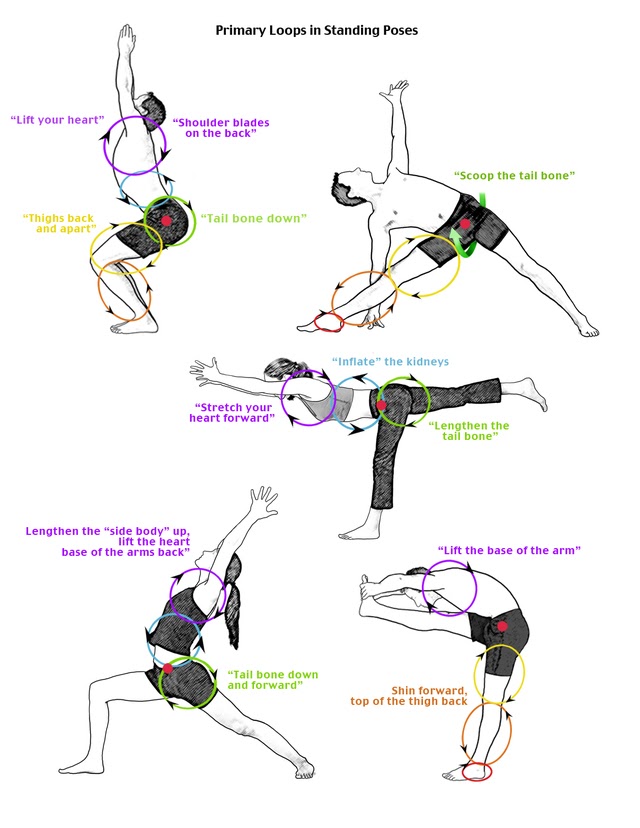
INNER SPIRAL An ever-expanding energy spiral that moves outward from the core; it runs from the feet up through the pelvis into the waistline area. Inner Spiral rotates the legs inward, moves the thighs backward, and widens the thighs and pelvis.
OUTER SPIRAL An ever-narrowing spiral that moves inward toward the core; it runs from the waistline area down through the tailbone and out through the legs and feet. Outer Spiral rotates the legs outward, moves the tailbone and thighs forward, and draws the pelvis and thighs closer together.
ORGANIC ENERGY An outward extension of energy from the Focal Point through the core lines of the body to the body's periphery, which increases expansion, flexibility, and freedom in the pose.
The Secondary Principles
FOCAL POINT A localized power spot within the body. Muscular Energy draws into it, and Organic Energy extends out from it. There are three possible locations for the Focal Point: the core of the pelvis, the bottom of the heart, and the upper palate. In any given pose, only one Focal Point is active. The active Focal Point is the one nearest the most weight-bearing part of the pose. When the three possible Focal Points are equally weight-bearing, the pelvic Focal Point becomes the active one by default.
SIDE BODY LONG Lengthening the sides of the ribs so the tops of the shoulders come in line with the base of the neck.
SHOULDER LOOP One of the seven energy loops within the body. This loop originates in the upper palate and flows backward to the base of the skull and down the back of the body to the bottom of the shoulder blades. When you engage Shoulder Loop, the head moves back slightly and the shoulder blades move down the back. At the bottom of the shoulder blades, the loop begins arcing forward and upward as it draws the bottom tips of the shoulder blades in and upward, toward the heart. The loop continues forward and up to the palate again as it lifts the chest and opens the throat.
INNER BODY BRIGHT A soulful expansion of feeling and vital energy from within the body that gives the outer form of the body a buoyant fullness. This attitude is created in the first principle, Opening to Grace, in which the fullness of the inner Self is embraced so the inner luster of Spirit naturally shines forth.

The yogi should continually practise showering himself with nectar. He becomes free from old age and liberated and devoid of all disease. He plays within the Ocean of Samsara, dearest one, is accomplished and independent -
Kaulajnananirnaya VII, 20
You are speech. You are consciousness. You are bliss. You are Brahma. You are being-consciousness-bliss. You are the non-dual. You are plainly Brahma. You are knowledge. You are intelligence - Ganapati Upanishad
Kaulajnananirnaya VII, 20
You are speech. You are consciousness. You are bliss. You are Brahma. You are being-consciousness-bliss. You are the non-dual. You are plainly Brahma. You are knowledge. You are intelligence - Ganapati Upanishad
Shoulder Alignment
SHOULDER SAVER - by Julie Gudmestad - Published in Yoga Journal, February 2008
Learning to engage and strengthen the rotator cuff muscles is crucial to preventing common shoulder injuries that plague yogis and non_yogis alike. If you know how to use these muscles the right way, your Down Dogs can help keep your shoulders strong and healthy for a lifetime.
The rotator cuff is one of the most important but widely misunderstood structures in the body. It gets damaged often enough that its name has become synonymous with injury. It's a group of four shoulder muscles that surround each shoulder—like a cuff. Boiled down to the essentials, its job is to support and position the ball that forms the head of the upper arm bone and fits in the socket of the shoulder joint. The shoulder is inherently an unstable joint, so building the strength of these supporting muscles is crucial. If they're weak or deconditioned, as is often the case, the shoulder is vulnerable to injury and pain, and the rotator cuff itself may tear.
You can remember the four rotator cuff muscles by the acronym SITS, for subscapularis, infraspinatus, teres minor, and supraspinatus. They all originate on the scapula (shoulder blade) and insert on the humerus (upper arm bone), near the humeral head (the ball that fits in the shoulder joint). The names of three of the muscles give you a clue to their location: subscapularis sits under the scapula, between the ribs and the front surface of the scapula. Supraspinatus sits above and infraspinatus sits below the spine of the scapula. You can feel them with your fingers: Touch one of your collarbones with the fingers of the opposite hand and slide the fingers straight up over the top of the shoulder. Then reach down the back about an inch or two; you'll find a ridge of bone that's more or less parallel to the ground. That is the spine of the scapula, which separates the supraspinatus and infraspinatus on the back surface of the scapula. The teres minor gives you no clues about its name; it just sits on the outer edge of the scapula, near the posterior fold of the armpit.
Shoulders 101
WHILE ALL FOUR MUSCLES work in concert to stabilize the shoulder, each muscle also helps support the shoulder individually. The subscapularis is a powerful internal rotator. Supraspinatus helps hold the ball up in its socket against the downward pull of gravity on the arm, and it initiates abduction, or lifting the arm up from your side, as in Virabhadrasana II (Warrior Pose II). Teres minor and infraspinatus are the primary muscles that control the external rotation of the shoulder. When they're strong and healthy, they help to protect the shoulder joint by positioning the ball in the socket while you raise your arm overhead. Conversely, their weakness can contribute to common shoulder problems such as shoulder impingement, tendinitis, and bursitis.
These important external rotators, infraspinatus and T. minor, are the part of the rotator cuff that is strengthened in Downward Dog. It's a good thing, too, because these days, the laborsaving products and devices we use make our arms and shoulders progressively weaker as the decades slip by. A weakened rotator cuff might lead to abnormal shoulder-movement patterns, which can contribute to inflammation and pain. Not only that, but weak muscles are likely to tear when you put a load on them that they aren't strong enough to handle. Sometimes the tears are microscopic and will heal on their own. But if the tears are bigger, a surgeon may have to sew the separated ends of the torn tissues together. Repairing a torn rotator cuff surgically, though, isn't a given: One doctor described the repair process as being like trying to sew up a run in a nylon stocking. The tissues of the atrophied muscles and their weakened tendons are just plain flimsy—liable to tear and difficult to repair.
So, a word to the wise: It's much easier to work your rotator cuff muscles, make them strong, and keep the tissues healthy than to have to see a physical therapist like me for shoulder treatment and rehabilitation or, worse still, to have to visit a surgeon. And it's in this way that your daily Downward Dog practice will really pay off—if, that is, you know how to engage infraspinatus and teres minor.
Right Rotation
PROPERLY ENGAGING THE EXTERNAL rotators takes some training. In fact, many students unknowingly let their shoulders slip into internal rotation in Downward Dog, leaving the external rotators lazy and inactive.
To get a feel for engaging the shoulder external rotators, stand facing a dining table or desk. Lean forward and place your hands on it, palms down and bearing a little weight. Now look at your elbows, noticing the crease on the inner sides and the point of the elbows on the outer sides. When you rotate your arms so that the elbow creases point forward, you will be externally rotating your shoulders. When you rotate in the opposite direction and the points of the elbows poke out to the sides, you will be internally rotating your shoulders. Play with this a bit by rotating in and out with this light amount of weight bearing, and you may even be able to feel the teres minor and infraspinatus contracting across the back of the shoulders as you turn the elbow creases forward.
Now go to your mat and do Down Dog. If you're a newer student or have tight shoulders, you may notice that they tend toward internal rotation, with the elbows sticking out to the sides and maybe even bent. Still in Dog, come forward a few inches toward Plank Pose and actively rotate the elbow creases relatively forward, so that they point toward your thumbs. Move back into Dog and try to keep some of this external rotation, though you'll have to give some of it up to fully open the shoulders. Maintaining some external rotation will keep the teres minor and infraspinatus contracting, and you'll probably notice more space opening up between your shoulder blades.
Once you've mastered keeping the external rotators engaged in Downward Dog, you can apply the action to more challenging poses such as Urdhva Mukha Svanasana (Upward-Facing Dog Pose) and Chaturanga Dandasana (Four-Limbed Staff Pose). From Downward Dog, come forward into Plank Pose. Rotate the creases of your elbows forward and hold your elbows against your sides as you let down to Chaturanga, then glide forward into Upward-Facing Dog. As you actively turn your elbow creases forward in this pose, the external rotators will be contracting strongly, and you should notice that this action broadens and lifts your chest.
Now notice how this shoulder rotation affects the weight placement in your hands. If the shoulders internally rotate, more weight tends to fall onto the inner side of the hand—that is, the thumb and index finger; in external rotation, the weight falls more onto the little-finger side. Ideally, your weight should be evenly balanced between your inner and outer hand, so that as you externally rotate at the shoulder, you'll need to focus on actively pressing down on the base of the index finger and thumb. This action of the forearm and hand is called pronation.
Typically, pronation of the forearm and hand occurs when the arms are internally rotated. For example, as I sit at my keyboard right now, palms down, my elbow points are sticking out to the side, which shows how pronation is linked with internal rotation. But Downward and Upward Dog require us to break our usual patterns by linking active shoulder external rotation with pronation of the hand. As you practice connecting these opposites, perhaps you'll appreciate anew how yoga helps you to break your old, unconscious habits in every aspect of life—and replace them with healthy, conscious, and considered ways of living.
_______________________________________________________________________
A pose can have exquisite alignment and be balanced in its Action, but without a pure spiritual expression from the heart, it loses its power for deep inner transformation. A pure spiritual expression from the heart, it loses its power for deep inner transformation. A pure spiritual expression in a posture is an unfolding of the deepest qualities of the heart, such as love and joy, into the body and surrounding environment. These pure heart qualities make a posture sing with a beautiful inner music, which harmoniously joins into the grand symphony of life. This heart energy (pure attitude) is the key element that makes the practice of hatha yoga into a profoundly transformational art. A pure attitude during the performance of asana purifies the body and mind and lets the light of the heart freely shine out.
~John Friend~
Practice transforms us. We need to eat less, because we assimilate more and more and therefore there is a loss of unnecessary weight. We become more and more beautiful, our faces change and our walk gains in elasticity. Our way of standing is steady and poised, our legs are firmer, and our toes and feet spread out, giving us more stability. Our chests expand, the muscles of the abdomen start to work, the head is lighter on the neck (like the corolla of a flower on its stem moving easily with flexibility while the wind blows). To watch these enchanting changes is amazing. A different life begins and the body expresses a happiness never felt before. These are not just words it actually happens.
-Vandra Scaravelli, Awakening the Spine
Subscribe to:
Posts (Atom)